For families and carriers
Information on choroideremia inheritance, genetic counselling, and modern medical options for safe family planning and the birth of healthy children
How is choroideremia inherited?
Choroideremia is inherited in an X-linked recessive pattern. This means the gene with the mutation is on the X chromosome. This determines very different disease courses in males and females.
Males
Males have only one X chromosome. If they inherit the X chromosome with a CHM mutation, the disease always develops, because they do not have a second “healthy” X chromosome to compensate for the defect.
Females
Females have two X chromosomes. If the mutation is present in only one of them, the woman becomes a carrier. The second (healthy) chromosome often compensates for the defect, so the disease frequently runs its course without symptoms. However, some female carriers may experience noticeable vision impairment.
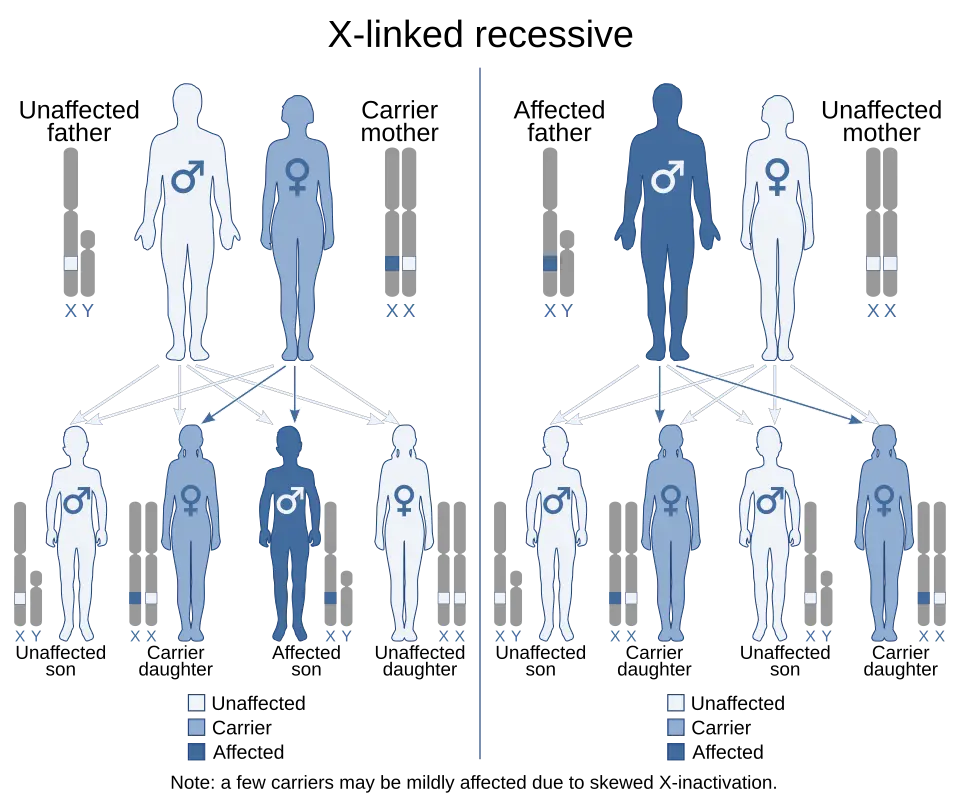
Probability of passing on the mutation
If the father has CHM and the mother is unaffected:
- • All daughters will be carriers (100%)
- • All sons will be unaffected (100%)
If the mother is a carrier and the father is unaffected:
- • 50% of daughters will be carriers, 50% unaffected
- • 50% of sons will be affected, 50% unaffected
Female carriers
Most often the disease is asymptomatic in women. However, carriers may sometimes show clinical signs of the condition:
- Mild changes: pigment spots or areas of retinal thinning (often detected only on examination in later adulthood).
- Symptomatic course (in rare cases): sometimes a woman may develop a full clinical picture of the disease with vision loss. This happens because of a random genetic process called “skewed X-chromosome inactivation” (when the chromosome with the mutation is more active in eye cells, and the healthy one is “switched off”).
Recommendation: female carriers should have regular ophthalmic examinations to monitor the condition of the retina.
Family planning
Today, couples at risk of passing on choroideremia have access to modern medical technologies. They help prevent the mutation from being passed on to future children.
Video from a medical geneticist (Russian)
Medical geneticist and ophthalmologist M.F. Pribytok, PhD, on reproductive options for inherited retinal dystrophies:
1. IVF + preimplantation genetic testing of embryos (PGT-M)
This is the most modern and safe approach to pregnancy planning. PGT-M (preimplantation genetic testing for monogenic disease) makes it possible to select only embryos that have not inherited the mutation for transfer.
- How it works: the couple undergoes standard IVF. On day 5–6 of embryo development, a biopsy of a few cells is performed for genetic analysis. Only a genetically healthy embryo is transferred to the uterus.
- Advantages: high probability of having a healthy child; avoids the need for pregnancy termination on medical grounds.
- Limitations: high cost; requires undergoing IVF.
Successful use of PGT-M for choroideremia, resulting in the birth of healthy children, has already been reported in international practice.
Link to publication →2. Diagnosis during pregnancy (prenatal diagnosis)
If pregnancy has already occurred naturally, the fetus’s genetic status can be checked before birth.
- How it works: the doctor performs chorionic villus sampling (at 11–14 weeks) or amniocentesis (at 16–20 weeks).
- Important to understand: these procedures are invasive (involving intervention in the uterus) and carry a small risk of pregnancy loss (~0.5–1%). The decision whether to continue or terminate a pregnancy if a mutation is found is made solely by the family.
Clinical experience: the literature describes a case of prenatal DNA diagnosis of choroideremia at 12 weeks of gestation by chorionic villus biopsy, showing absence of the mutation in the fetus.
Link to publication →3. Genetic counselling
When planning a pregnancy, we strongly recommend consulting a medical geneticist.
The specialist will help calculate the risks for your family, explain available procedures (IVF, testing) in detail, and provide support in making informed decisions.
Have questions?
Book a medical genetics consultation or discuss reproductive planning questions in the community