A community for people affected by choroideremia
Information about the disease, modern treatment approaches, and support from people who understand

Development of a choroideremia gene therapy program has started in Russia
RetinaFond, together with Sechenov University, has started developing a domestic gene therapy candidate for choroideremia.
Where should I start?
Choose the section you need
First steps after diagnosis
What to do next? Clear steps, genetic testing, and emotional support
For families and carriers
Information on inheritance, family planning, and genetic counselling
Treatment and research
Treatment options, clinical trials, and research news
Need support
Telegram community, contacts, and stories from other people with CHM
What is choroideremia?
Choroideremia (CHM) is a rare inherited retinal disease that causes progressive vision loss. It is caused by a mutation in the CHM gene on the X chromosome.
The disease gradually affects three key retinal structures: the choroid, the retinal pigment epithelium (RPE), and the photoreceptors.
The first symptoms usually appear in childhood as night blindness (nyctalopia) — difficulty orienting in dim light or darkness. Over time, progressive narrowing of peripheral visual fields leads to “tunnel vision,” where only a small area of central vision remains.
Key facts:
- ✓ Estimated prevalence is approximately 1 in 50,000 people
- ✓ X-linked recessive inheritance — the disease predominantly affects males
- ✓ Female carriers usually have no vision problems, although in rare cases varying degrees of impairment may occur
- ✓ International clinical trials of CHM gene therapy are actively underway
Main symptoms
What happens to vision in choroideremia
Night blindness
Worsening vision in dim light and slow eye adaptation when moving from bright light into darkness
Tunnel vision
Gradual narrowing of peripheral (side) vision, leaving only a small area of central vision
Progressive course
Gradual vision loss over decades. The pace of change is strictly individual
How is CHM inherited?
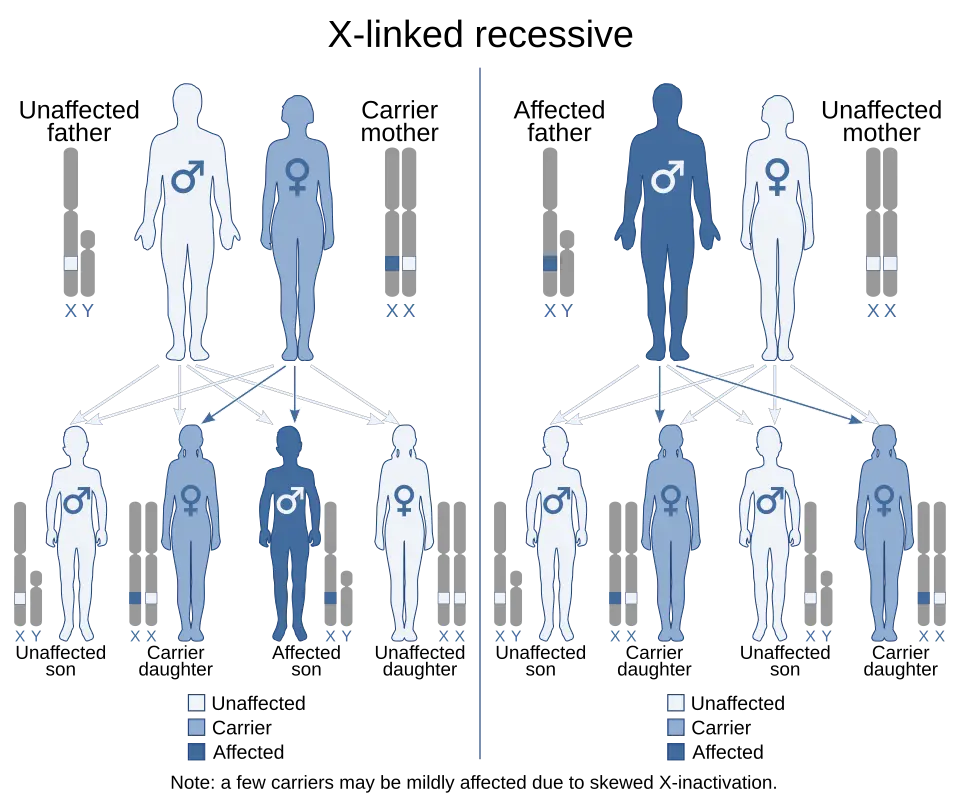
Choroideremia is inherited in an X-linked recessive pattern. This means the gene with the mutation is on the X chromosome. This determines very different disease courses in males and females.
Males
Males have only one X chromosome. If they inherit the X chromosome with a CHM mutation, the disease always develops, because they do not have a second “healthy” X chromosome to compensate for the defect.
Females
Females have two X chromosomes. If the mutation is present in only one of them, the woman becomes a carrier. The second (healthy) chromosome often compensates for the defect, so the disease frequently runs its course without symptoms. However, some female carriers may experience noticeable vision impairment.
We are here for you
Join the Telegram community: connect with people who have similar experience, ask questions to specialists, and stay up to date on research.
Join the Telegram Community